
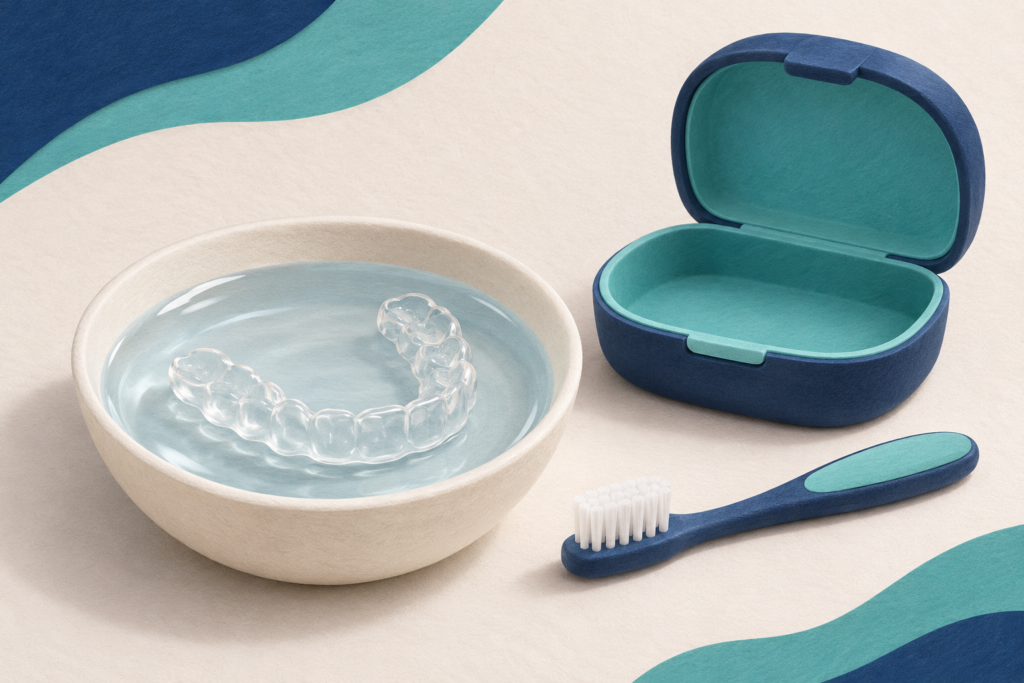
Follow the cleaning instructions for your particular retainer. A clear removable tray and a wire bonded behind the teeth need different care, so a single online cleaning recipe is not suitable for every appliance.
Clear removable retainers
Ask your clinician which brush, cleaning product and routine are appropriate for the material. Avoid hot water: it can distort a plastic retainer. Nottingham University Hospitals' care guidance highlights this risk and the importance of protective storage.
Do not improvise with boiling water, bleach or abrasive products. Follow the manufacturer's instructions for any recommended cleaner, including rinsing and contact time. Clean the storage case as instructed too, and keep the appliance away from pets and heat.
Fixed wires behind the teeth
A fixed retainer remains attached during cleaning. Ask your dental team to demonstrate how to clean the teeth and around the wire, including any suitable interdental aid. Do not pull on the wire or try to remove bonded material yourself.
If you cannot reach an area, tell the team rather than simply leaving it uncleaned. A demonstration with your own appliance is more useful than choosing a tool from a general photograph.
What to check at a review
- Am I using an appropriate cleaner for this material?
- Can you show me how to clean any difficult areas?
- Is the tray worn, cracked or distorted?
- Is the fixed wire still securely attached?
- How should I store the appliance when it is not worn?
- When should the retainer and gums be reviewed again?
Bring removable appliances to relevant dental appointments so the fit and condition can be assessed. Report a persistent odour, deposits, a sharp edge or a changed fit instead of using stronger chemicals to mask a problem.
Our retainers page provides the treatment overview. For broader daily care, see our dental hygiene information. Cleaning supports appliance care but does not replace the prescribed wear schedule or professional checks.
Clinical Note: Any surgical or invasive dental procedure carries risks. Before proceeding, you should seek an opinion from an appropriately qualified dental practitioner. The information on this website is for general educational purposes only.